
A Sandwell advert appeal has overturned the refusal of two digital display screens in Oldbury after the Inspector discovered that a highways objection recorded in the council officer report did not match the highway authority’s actual response. Inspector Jennifer Vyse granted express advertisement consent on 20 November 2026.
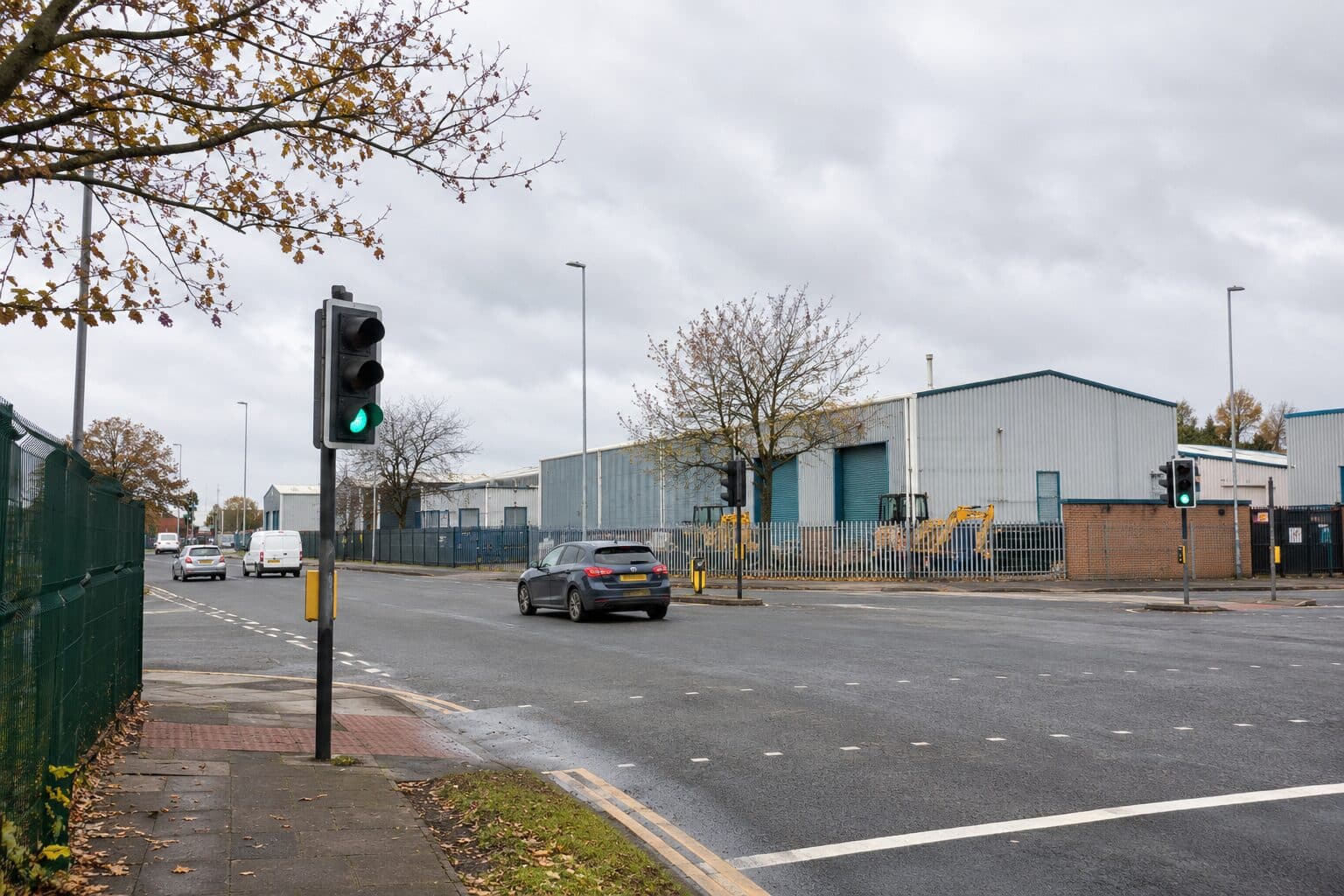
The proposal concerns the MCS Plant Hire Group premises on Gregston Industrial Estate, beside the signal-controlled junction between an estate road and Birmingham Road, the A457 Oldbury Ringway. The screens would stand in a shallow V formation in the operating yard and show static advertisements in rotation.
The Sandwell advert appeal is particularly relevant to applicants and councils because the Inspector checked the underlying consultation evidence rather than relying solely on an officer report. She then assessed the actual public safety implications and imposed specific controls on brightness, display duration and animation.
Why the Sandwell advert appeal succeeded
The application, DC/26/6998A, was determined under the Town and Country Planning (Control of Advertisements) (England) Regulations 2007. The statutory decision for express advertisement consent turns on amenity and public safety. The Inspector recorded no concern about visual amenity, leaving road safety as the central issue.
The council’s officer report had described the highway authority as opposing the signs because an advertisement board could obscure a traffic signal from drivers. However, the consultation response included in the appeal material said the highway authority had no objections. Inspector Vyse sought clarification from Sandwell rather than assuming the report was accurate.
The council confirmed that the highway authority had not objected and that, in the Inspector’s words, “the officer report appears to relate to an incorrect site”. That is a significant factual correction, although it does not mean the Inspector automatically allowed the scheme or found wider failings in the council’s procedures.
The Sandwell advert appeal was ultimately decided on the evidence and conditions for this particular junction. The absence of a highways objection mattered, but the Inspector also considered the proposed location, visibility, traffic controls and potential distraction independently.
Two large screens beside traffic signals
Each proposed digital screen would measure six metres across and three metres high, supported on a single pole, with the bottom of the display between approximately 2.65 and 3.07 metres above footway level. Their positions within the yard would be visible to drivers using the nearby signal-controlled junction.
The Inspector noted that traffic signals included a pedestrian phase, but that the approach along Birmingham Road gave drivers good forward visibility. The road was generally well lit, speeds were controlled and a Red Route restriction limited parked or waiting vehicles on the approach.
Planning Practice Guidance recognises that advertising near junctions can raise safety concerns, especially when it obscures signals, confuses road users or distracts attention at a point requiring additional care. Equally, commercial and industrial settings are not necessarily unsuitable for advertising simply because a road junction is nearby.
In the Sandwell advert appeal, the Inspector considered there was no persuasive basis to conclude that the proposed screens would materially interfere with the traffic signals or create an unacceptable road safety distraction in their setting. The finding was not an unrestricted endorsement of digital advertising alongside traffic lights elsewhere.
Conditions limit light and moving imagery
Inspector Vyse attached three additional conditions alongside the five standard conditions under the advertisement regulations. The first controls display brightness, limiting night-time luminance to 300 candelas per square metre and setting a maximum daytime value of 5,000 candelas per square metre, with output adjusted to ambient conditions.
The second requires every advertisement to remain displayed for at least ten seconds, with the change between adverts taking no more than one second. Changes must be immediate and without transition effects, including fades, swipes or animation. A malfunction or unused screen must revert to black or blank.
The third rules out interactive advertising, moving or apparently moving images, animation, video and full-motion content. It also prevents images resembling traffic signals, official road signs or matrix signs. These are substantive limitations on the operation of the signs, not merely suggestions about good practice.
The highway authority also sought a condition about obtaining a permit to alter an existing road sign within the highway. The Inspector declined to repeat that requirement as a planning condition because the permit process was governed by separate legislation.
Advertisement consent and planning policy
The council identified development plan policies it considered relevant, including local policy concerning poster panels and highway safety. The Inspector nevertheless distinguished those policies from the narrower statutory remit for deciding an advertisement consent application. Amenity and public safety remained the relevant considerations, with policy treated as a material consideration rather than as a separate test.
The decision also referred to the revised National Planning Policy Framework of 17 August 2026. The Inspector considered that version relevant to planning decisions but recorded that it contained no specific advertisement-control provision. She did not regard it as changing the matters that required consideration on this appeal.
For a useful explanation of the separate rules governing signs, see Planning Geek’s guide to advertisement deemed consent. The Oldbury proposal required express consent, but understanding when advertisements benefit from deemed consent helps establish the correct regulatory route before a proposal is designed.
What the Sandwell advert appeal means for applicants
The immediate lesson from the Sandwell advert appeal is to obtain and read the actual consultation responses, particularly where a refusal relies on technical advice. A statement in an officer report that a highway authority objects may not accurately describe the consultation record. Any discrepancy should be checked and resolved rather than treated as a reason to ignore genuine safety concerns.
Applicants proposing digital displays should also submit precise details of screen size, orientation, operating characteristics and lighting. A convincing scheme may still require enforceable safeguards around brightness, static display time and simulated traffic-control imagery, especially beside signal-controlled roads.
The Sandwell advert appeal demonstrates that a site-specific road safety assessment can distinguish a proposal that is acceptable with conditions from one which poses unacceptable risk. A previous consent for digital billboards at the premises was mentioned, but the Inspector did not treat it as determinative because its dimensions and exact location were not established.
The appeal was made by MCS Plant Hire Group Limited against Sandwell Metropolitan Borough Council and was allowed on 20 November 2026 under reference 6014838. The Planning Inspectorate case record contains the official appeal reference. The appeal decision is also available on AppealBase.



0 Comments