
Applications, appeals, permitted development, enforcement and planning strategy across England







Planning explanations, updates and practical guidance in video form
Use Class C4 – Houses in multiple occupation (HMOs)
Use Class C4 of the Use Classes Order 1987 (as amended) covers the use of a dwellinghouse by not more than six residents as a house in multiple occupation. A recent Enfield appeal involving seven residents is a useful illustration of the point at which a larger HMO moves outside C4 and into sui generis use.
Interpretation of Class C4
For Class C4, a house in multiple occupation does not include a converted block of flats to which section 257 of the Housing Act 2004 applies. Otherwise it has the same meaning as in section 254 of the Housing Act 2004.
The Housing Act definition is wider and more detailed than the shorthand often used in property advertising. Broadly, the occupation must satisfy one of the statutory HMO tests, involve more than one household and meet the relevant only-or-main-residence requirements.

What constitutes a C4 dwelling?
A C4 dwelling is a property occupied by between 3 and 6 residents forming more than 1 household who share basic amenities such as:
-
Kitchen
-
Bathroom
-
Living areas
This use class covers small HMOs, including shared houses, student accommodation (not purpose-built halls of residences, as these are likely to be Sui Generis), and other co-living arrangements. This might include a house converted to bedsits, which is let to 3 or more tenants.
Note that it is often described as between 3 and 6 unrelated individuals, but this could be wrong as one married couple and one single person renting two rooms would still be classed as a C4 HMO.
Count residents rather than bedrooms. The number of bedrooms does not determine whether the use falls within C4 because people can share, rooms can be vacant and bedrooms can be used for other purposes.
When considering if a property is an HMO as opposed to say C3 dwelling, the factors to be considered include whether the persons living in the house came to it as a single group or whether they were independently recruited; what facilities were shared; whether the occupants were responsible for the whole house or just their particular rooms; whether individual tenants were able to lock other occupiers out of their rooms; whose responsibility it was to recruit new occupiers when individuals left; who allocated rooms; the size of the property; how stable the group composition was; and whether the mode of living was communal.
Importantly the property must be used as the tenants only or main residence and share basic facilities. Students would count as this.
Shared facilities are important evidence in many C4 cases, but the Housing Act contains more than one HMO test and the planning position remains fact-sensitive. Adding a full kitchen and bathroom to individual rooms can create a risk that separate self-contained dwelling units or planning units have arisen. Ask how the accommodation is actually occupied, managed and accessed rather than assuming that one appliance changes the use by itself.
Please note that a bugbear of ours is when people write HMO’s – it is HMOs – there is no apostrophe! Now we have that out of the way, let’s continue! 🙂
If an HMO has more than 6 residents and a material change of use has occurred then it will require full planning to become a Sui Generis HMO. If you require assistance with planning permission for a Sui Generis HMO please either request a free fee proposal. Our team of planning consultants are here to help.
A September 2026 Plymouth appeal shows how amenity and parking can then become important planning issues for a larger HMO. Permission was granted to increase a six-person C4 HMO to nine residents even though the private outdoor space was around half the figure indicated by the council’s SPD. The Inspector did not ignore the standard; the SPD itself required a flexible, site-specific assessment and nearby public green space helped to mitigate the shortfall. See our Plymouth HMO appeal report for the full decision.
A group of students living together, even if on one AST, would usually be considered an HMO. This is as long as they are not living together as ‘one household’. If they are then the property might be considered under Use Class C3.
Does a C4 HMO have permitted Development Rights?
We believe they do. This is backed up by case law.
The High Court judgment handed down on 29th July 2022 supports this. In London Borough of Brent v Secretary of State for Levelling Up, Housing and Communities & Anor [2022] EWHC 2051 (Admin), the question arose whether a building in Use Class C4 was a “dwellinghouse” for the GPDO.
Deputy Judge Robert Palmer QC held that a building in Use Class C4 is a dwellinghouse, but he was careful not to say that every form of HMO automatically falls within the GPDO definition. Some HMOs, such as self-contained flats or converted buildings containing a flat, are expressly excluded. An HMO outside Class C4, including a larger sui generis HMO, may still be a dwellinghouse, but that depends on the facts and the Gravesham test.
In determining the meaning of “dwellinghouse” the Deputy Judge set out legal principles including:
- A dwellinghouse is a unit of residential accommodation which provides the facilities needed for day-to-day private domestic existence (the Gravesham test, judgment 8th November 1982, reported at (1984) 47 P&CR 142)
- Whether any particular building is or is not a dwellinghouse is a question of fact
- Use Category C3 is not exhaustive of the uses to which a dwellinghouse may be put
- There is no requirement for a dwellinghouse to be in use by, or akin to, “a single household”. That is a concept confined to Class C3 dwellinghouses
- It is wrong to say that all C4 HMOs are a dwellinghouses for the GPDO, because a C4 HMO may include flats, which are excluded from the definition of “dwellinghouse” in the GPDO
Part 1 of the GPDO can extend to an HMO where the building is a ‘dwellinghouse’ for GPDO purposes and the particular right’s other limitations and conditions are met. It should not be assumed that every HMO automatically benefits from Part 1. If you are refused this or need a certificate of lawfulness, please contact us for help.
A larger HMO outside Use Class C4 can still be a dwellinghouse for GPDO purposes, but Brent does not make that automatic. The question is whether the particular building remains a dwellinghouse on the facts, including the Gravesham test and the GPDO exclusion for flats.
If at any time you are going from C3 to C4 and there is a question as to when an extension is considered to be lawful, it was held in LB of Brent V SSLUHC & Yehuda Rothchild [2022] EWHC 2051 (Admin), that it matters not in which order such matters are considered, as the permitted development rights for extensions extend to properties falling within both use classes.
Can C4 dwellings be blocked?
Many local authorities use an Article 4 direction to withdraw the Class L right from C3 to C4 in a defined area. Check the sealed direction itself because the area, withdrawn right and effective date vary.
A direction can be made with a future effective date or brought into force immediately. Immediate withdrawal can create potential Article 4 compensation exposure for the authority during the statutory period, so do not assume that every HMO direction provides 12 months’ warning.
We are building our own map of local authorities that block HMOs via an Article 4 – click here to view that page. We also include the link to the Article 4 Direction, a link to a map if not in the direction and the date when the Article 4 came in.
Where an Article 4 direction is approaching, the important question is whether the property is already in lawful C4 use before the relevant right is withdrawn. Actual occupation by three to six residents forming more than one household is strong evidence, but one snapshot either side of the effective date is not a statutory safe-harbour test. Tenancies, council-tax or licensing records, dated photographs and the pattern of occupation may all matter.
A Certificate of Lawfulness of Existing Use or Development can confirm the established planning use, particularly before purchase, refinancing or a later occupancy change. Our guide to proving a lawful HMO explains the different routes and supporting evidence, including why a lawful Class L conversion does not need ten years of occupation.
An empty property, or a temporary fall below three occupiers, does not necessarily switch an established C4 use to C3 automatically. The question is whether the lawful C4 use has been abandoned or a material change of use has occurred. Long vacancy, a new pattern of occupation, physical conversion and the owner’s intentions may all be relevant. Where the evidence does not establish an existing C4 use, planning permission may be required to begin or resume that use after the direction takes effect.
Many HMO Article 4 directions withdraw the Class L right from C3 to C4 while leaving the reverse C4 to C3 right untouched, but the wording of the particular direction is what matters. Always check exactly which permitted development right has been withdrawn in the area rather than assuming every HMO Article 4 has identical scope.
A C4 dwelling can also be blocked via other legislation. For example a building converted under Class MA is excluded from being a C4 dwelling via permitted development. Also it can be achieved via full planning.
Finally C4 may be blocked via a condition on a previous planning decision.
You might consider planning permission as an alternative if an Article 4 is blocking HMOs in your area. This might be possible. Although where a local authority has a policy in place to prevent the loss of a family home, that might fail. For example The London Borough of Croydon has Policy DM1.2 of the Croydon Local Plan 2018 which seeks to retain and provide family homes and states that the Council will permit the redevelopment of residential units where it does not result in the net loss of 3 bedroom homes (as originally built) or the loss of homes smaller than 130 sqm. So it is worth checking the local plan to see if your conversion to an HMO is compliant.
How do I check for an Article 4 in my area?
We are building our own map of local authorities that block HMOs via an Article 4 – click here to view that page. We also include the link to the Article 4 Direction, a link to a map if not in the direction and the date when the Article 4 came in.
So for example ‘Birmingham City Council Article 4’ (without the single quotes) will give you this page as the top result (not always top, but should be there somewhere). From there we recommend reading the Article 4 Direction, which will tell you exactly what is prevented.
On the page linked above you will find this document – open and read that (or your local authority version) and you ought to find a map and description of what is blocked (Schedule 1 in this example). (click to enlarge map)
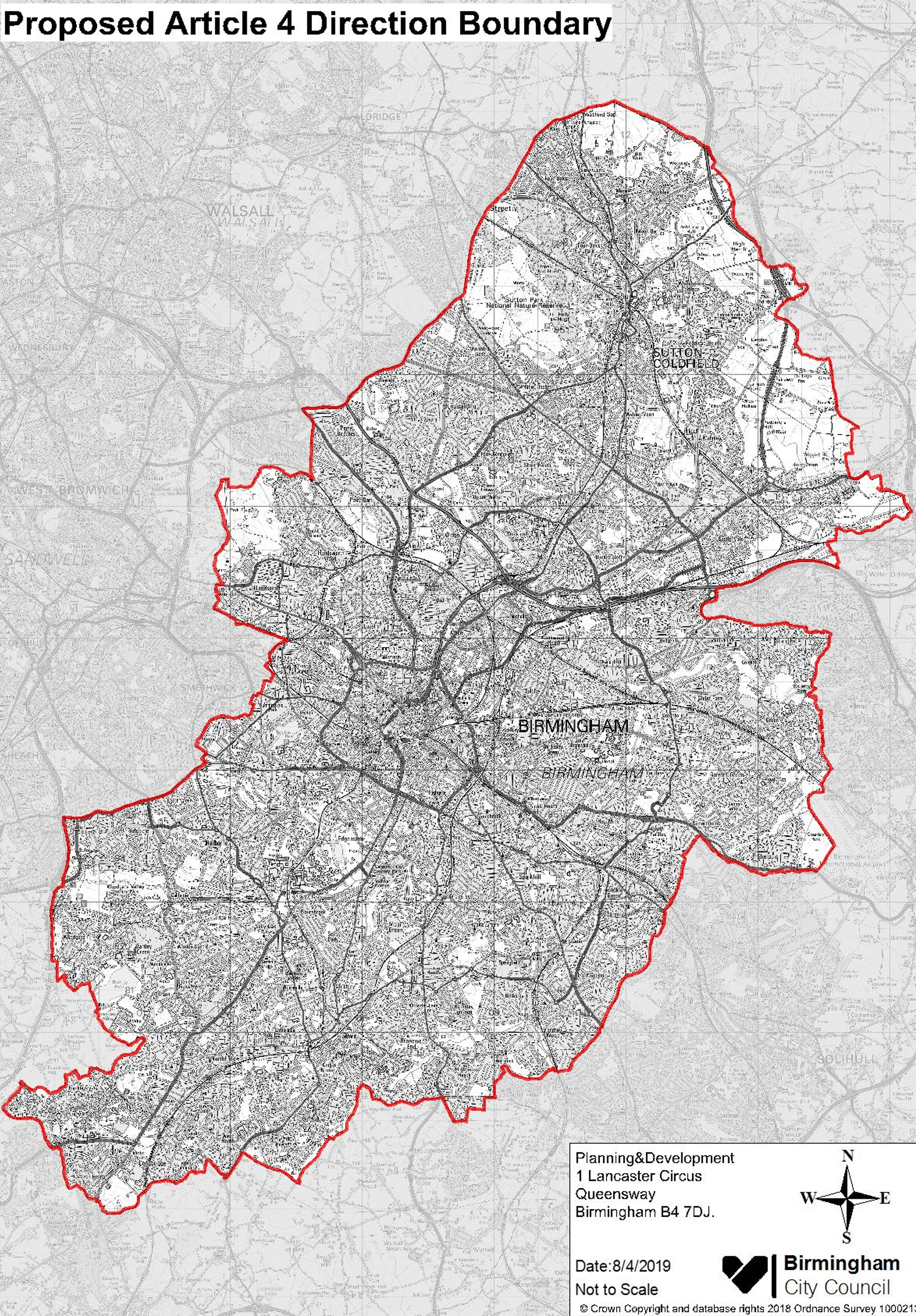
It says ‘Development consisting of a change of use of a building from a use falling within Class C3 (dwellinghouses) of the Schedule to the Town and Country Planning (Use Classes) Order 1987 (as amended) to a use falling within Class C4 (houses in multiple occupation) of that Schedule, being development comprised within Class L(b) of Part 3 of Schedule 2 to the Town and Country Planning (General Permitted Development) Order 2015 and not being development comprised within any other Class.’
Note: the Birmingham wording quoted above withdraws Class L(b), the C3-to-C4 direction of travel, rather than Class L(a), which permits C4 to C3. That does not mean a short vacancy or temporary occupancy below three people automatically exercises Class L(a). A material change to C3 must occur on the facts. Keep clear records of the established C4 use and obtain a CLEUD where certainty is commercially important.
If you have an HMO in Birmingham Article 4 area, we strongly recommend that you get a Certificate of Lawfulness now to help prevent you accidentally losing your C4 HMO – contact us for a fee proposal.
Getting planning in an Article 4 area for an HMO?
It is quite possible to get planning in an Article 4 area for HMOs except where policy exists to prevent it (see above). An Article 4 direction removes a permitted development right; it does not itself create a blanket ban on HMOs. The 2026 Ipswich HMO appeal is a useful example. A 16-person sui generis HMO was allowed inside an HMO Article 4 area because the proposal required express planning permission in any event and was assessed against the local HMO policy on its merits.
The criteria for an HMO planning application ought to be published in the local plan. Take our example of Birmingham City Council. Their policy is contained within DM11 which is a policy within their Development Plan Document. Your local authority ought to have similar.
It says:-
Proposals for the conversion of existing dwellinghouses or the construction of new buildings to be used as Houses in Multiple Occupation (HMO) should protect the residential amenity and character of the area and will be permitted where they:
a. Would not result in this type of accommodation forming over 10% of the number of residential properties within a 100 metre radius of the application site.
b. Would not result in a C3 family dwellinghouse being sandwiched between two HMOs or other non-family residential uses.
c. Would not lead to a continuous frontage of three or more HMOs or non-family residential uses.
d. It would not result in the loss of an existing use that makes an important contribution to other Council objectives, strategies and policies.
e. Would not give rise to unacceptable adverse cumulative impacts on amenity, character, appearance, highway safety and parking.
f. Provide high quality accommodation with adequate living space including:
• Bedrooms of at least 7.5 sq.m. (single) and 11.5 sq.m. (double).
• Communal living space comprising lounge, kitchen and dining space either as distinct rooms or in an open plan format.
• Washing facilities.
• Outdoor amenity space.
• Recycling / refuse storage.
If you comply with the policy there is no reason why you shouldn’t be able to get an HMO in an Article 4 area. However our consultants at Planning Geek are well experienced at obtaining planning in such areas, so please contact us for a free fee proposal. We are here to help.
Can I make my HMO rooms self-contained?
You need to be careful if you do. What do we mean by this? Essentially can you take a bog standard HMO room perhaps with an en-suite and then add a sink and cooking facilities. If you make them self-contained you are by default perhaps creating separate dwellings within the building. Doing this would require full planning permission.
There is potentially a difference between a tea-station and a full oven with cooking facilities. You should keep an element of shared basic facilities.
But what if you created some self-contained. Previously we might have said don’t for the reason above. However a recent High Court decision might be to your benefit.
Welwyn Hatfield Borough Council served an enforcement notice in July 2019 over a two-storey detached house in Hatfield. Conversion works meant it comprised four bedsitting rooms, each self-contained with its own kitchen and bathroom, plus two further bedrooms each with access to a bathroom on the first floor and a kitchen on the ground floor, plus a lounge which was accessible to all residents. Welwyn Hatfield issued the notice on the basis that these arrangements had resulted in the subdivision of the house into five self-contained flats, in breach of planning control.
The inspector visited and concluded it was a house in multiple occupation for not more than six residents, and so fell within the scope of Use Class C4. However the council then appealed to the High Court.
Timothy Mould KC, sitting as a deputy High Court judge, said Whether the four self-contained units, the bedsits, were being used as single dwellinghouses was a question of fact and degree for the inspector to determine on the basis of the evidence before him, including what he observed during his site visit.” He said the law meant it was in principle possible for a house to remain a single dwellinghouse under Use Class C4, even with a mixture of self-contained and shared residential accommodation. The Deputy Judge said. “Nevertheless, he referred also to the existence of communal facilities which were accessible to all occupiers of the house. In the light of those matters, I see no particular difficulty in understanding how and why he came to the conclusion that he did.”
What is very important here is that shared facilities still existed. Had they all been removed then there is no doubt that the decision would have gone against the applicant. Every case is different and we can’t guarantee that yours would be the same. But if you keep shared facilities you might be okay if this judgement is anything to go by.
Permitted Development Changes for Use Class C4
There is one development right to go from or to C4 from/to any other use class.
From another use to Use Class C4:
Class L – C3 dwellinghouse to C4 HMO
Where occupation changes so that the dwelling is used by three to six residents forming an HMO, the planning use may move from C3 to C4. Class L can permit that change without a planning application where the right is available, but an Article 4 direction or another restriction may remove it. A certificate of lawfulness can provide useful confirmation where certainty is needed.
From Use Class C4 to another use:
Class L – C4 to C3 dwellinghouse
If you require assistance with planning permission please either request a free fee proposal, or book a Zoom call with Ian, the founder of Planning Geek. Our team of planning consultants are here to help.
Examples for Use Class C4
According to the Planning Geek directory of uses, C4 includes Bungalows, Flats, and houses that are occupied by between three and six unrelated residents and bedsits (assuming they qualify as C4s as above).
Use Class C4 Page Updated: 19th September 2026
Explore the Use Classes section
Use Classes Home · Use Classes Index · Use Classes Directory