Applications, appeals, permitted development, enforcement and planning strategy across England
Class C demolition of gates, fences and walls
Class C of Part 11 grants planning permission for the demolition of the whole or any part of a gate, fence, wall or other means of enclosure, but only where the demolition is not relevant demolition in a conservation area.
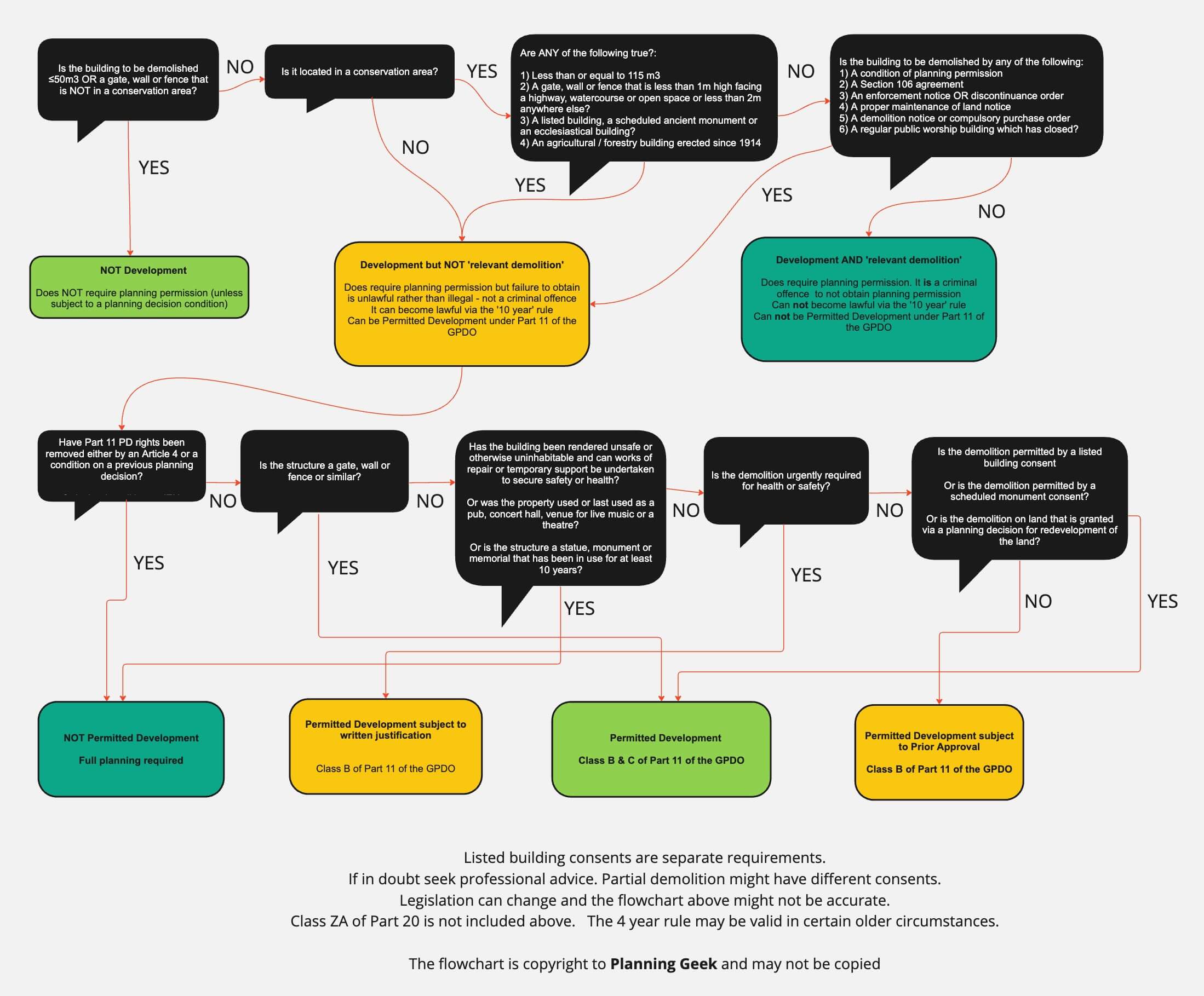
There is an important twist. Outside a conservation area, demolition of the whole or part of a gate, fence, wall or other means of enclosure is normally not development at all under the Town and Country Planning (Demolition – Description of Buildings) Direction 2021. In those cases you do not normally need Class C because planning permission is not required for the demolition in the first place.
Class C becomes particularly important in a conservation area, because the 2021 Direction deliberately removes that exemption there. You then need to decide whether the wall, fence, gate or enclosure is excluded from relevant demolition and can therefore use Class C.
For the full sequence, including the separate 50 m³ and 115 m³ rules for buildings, see our detailed guide to Class B demolition and relevant demolition.

Need help with a planning application?
Planning Geek isn’t just a reference site - preparing and submitting planning applications is what we do. If you’d like a hand with an application, an appeal or any other planning matter, we’d be glad to help.
Class C in a conservation area
The Conservation Areas Direction 2015 excludes certain walls, gates, fences and other means of enclosure from section 74 of the Planning (Listed Buildings and Conservation Areas) Act 1990. They are not relevant demolition where they are:
- less than 1 metre high where they abut a highway, including a public footpath or bridleway, a waterway or open space
- less than 2 metres high in any other case
Because demolition of such an enclosure in a conservation area is development under the 2021 Direction, Class C is the permitted development right which can grant the planning permission. Class B is not required for a wall, gate or fence.
If the enclosure is at or above the relevant 1 metre or 2 metre threshold, the demolition may be relevant demolition under section 196D of the Town and Country Planning Act 1990. Class C expressly does not permit relevant demolition, so a planning application may then be required.
Class C can cover part of a wall or enclosure
Unlike Class B, Class C expressly covers demolition of the whole or any part of a gate, fence, wall or other means of enclosure. But that wording does not allow relevant demolition to bypass section 196D.
In Barton v Secretary of State for Communities and Local Government and Bath and North East Somerset Council [2017] EWHC 573 (Admin), the High Court considered the removal of a pedestrian gate, lintel and approximately 2.5 metres of historic wall in Bath Conservation Area. The court upheld the Inspector’s conclusion that the works amounted to demolition and confirmed that, under the post-2013 section 196D regime, demolition of part of a building can be caught.
This means that describing work as “only part of the wall” is not enough. The height thresholds, the nature of the structure and whether the work is demolition rather than alteration all need to be considered.
Article 4 directions and other controls still matter
Class C can be removed by an Article 4 direction or restricted by a condition on an earlier planning permission. Separate controls can also apply where the enclosure forms part of a listed building or scheduled monument, or where other legislation is engaged.
If full planning permission is required for demolition in a conservation area, the decision-maker must also apply the conservation-area duty in section 72 and the current heritage policies in the August 2026 NPPF. Our heritage significance and harm guide explains that assessment.
Current Class C legislation
Class C – demolition of gates, fences, walls etc
Permitted development
C. Any building operation consisting of the demolition of the whole or any part of any gate, fence, wall or other means of enclosure.
Development not permitted
C.1 Development is not permitted by Class C if the demolition is “relevant demolition” for the purposes of section 196D of the Act (demolition of an unlisted etc building in a conservation area)
Conservation, Heritage & Protected Sites
Heritage
- Conservation & heritage home
- Conservation Index
- Heritage significance and harm
- Heritage Impact Assessments
- Setting of a heritage asset
- Listed buildings
- Conservation areas
- PD rights in conservation areas
- PD rights affecting listed buildings
- Non-designated heritage assets
- Archaeology and planning
- Ridge and furrow planning
- Registered parks and gardens
- Registered battlefields
- Protected wreck sites
- World Heritage Sites
- Scheduled monuments
- Scheduled monument consent
Heritage applications & enforcement
Protected landscapes
- National Landscapes (AONBs)
- AGLV (Area of Great Landscape Value)
- Local landscape designations
- Landscape character assessment
- Landscape and Visual Impact Assessment (LVIA)
- EIA screening and scoping
- PD rights in National Landscapes (AONBs)
- National Parks
- PD rights in National Parks
- The Broads
- Heritage Coast
Land & flood constraints
- Green Belt, grey belt, greenfield & brownfield
- Metropolitan Open Land (MOL)
- Strategic gaps, green wedges & settlement gaps
- Local Green Space
- Open space, playing fields & sports land
- Common land & village greens
- Flood zones
- Flood Risk Assessment (FRA)
- Coastal Change Management Areas
Nature & protected sites
- Habitats Regulations Assessment (HRA)
- Environmental Delivery Plans & Nature Restoration Fund
- Priority habitats & species
- Irreplaceable habitats
- Limestone Pavement Orders
- Local Wildlife Sites and Local Geological Sites
- Local Nature Recovery Strategies (LNRS)
- Green infrastructure
- Nature reserves (NNRs and LNRs)
- Marine Conservation Zones
- Nutrient neutrality
- Water scarcity
- Chalk streams & planning
- Fish pass planning permission
- Water neutrality
- Air pollution and protected sites
- Special Protection Areas (SPA)
- Special Areas of Conservation (SAC)
- Ramsar sites
- Sites of Special Scientific Interest (SSSI)
- SANG & recreational mitigation
- Ancient woodland & veteran trees
- Trees and planning
- Tree Preservation Orders
- Biodiversity Net Gain
- Conservation covenants
- Field hedgerows
- Hedgerow Removal Notice
- Protected species
- Preliminary Ecological Appraisal (PEA) & EcIA
- Ecological survey calendar
Class C Demolition Page Updated: 20th August 2026